Start from group policy optimization
Sample a group of outputs, compute task rewards, and obtain the original base advantage.
GRPO / DAPO / GSPO → Āi
1Peking University 2JD Explore Academy, China 3Beijing Institute of Technology
*Equal contribution †Project leader
 2026
2026
SetPO integrates each trajectory’s marginal diversity contribution as a plug-in shaping term for group policy optimization. It uses the standard rollout group and the base advantages produced by GRPO, DAPO, or GSPO.
Sample a group of outputs, compute task rewards, and obtain the original base advantage.
GRPO / DAPO / GSPO → Āi
Embed complete trajectories and compute pairwise semantic similarities within the same group.
Kij = k(oi, oj)
Aggregate local semantic mass over the sampled trajectories to evaluate the generated batch as a whole.
Ω = {o₁, …, oG} → D(Ω)
Contrast the full-set estimate with the subset that excludes one trajectory.
si = D(Ω) − D(Ω ∖ {oi})
Add the weighted credit to the base advantage, then use the augmented advantage in the original surrogate objective.
Âi = Āi + λsi
Unlike methods that focus on diversity at the token level, SetPO evaluates complete outputs semantically. It uses a bounded, symmetric similarity kernel k(y, y′) ∈ [0, 1] and a pre-defined semantic embedding function e(·).
A high local mass indicates that y resides in a crowded neighborhood, implying redundancy. A low value places y in a sparse region, signifying relative novelty.
SetPO aggregates the local semantic mass over the sampled set. Let g : [0, 1] → ℝ be a continuous, non-increasing function. The paper adopts g(x) = −log(1 + x).
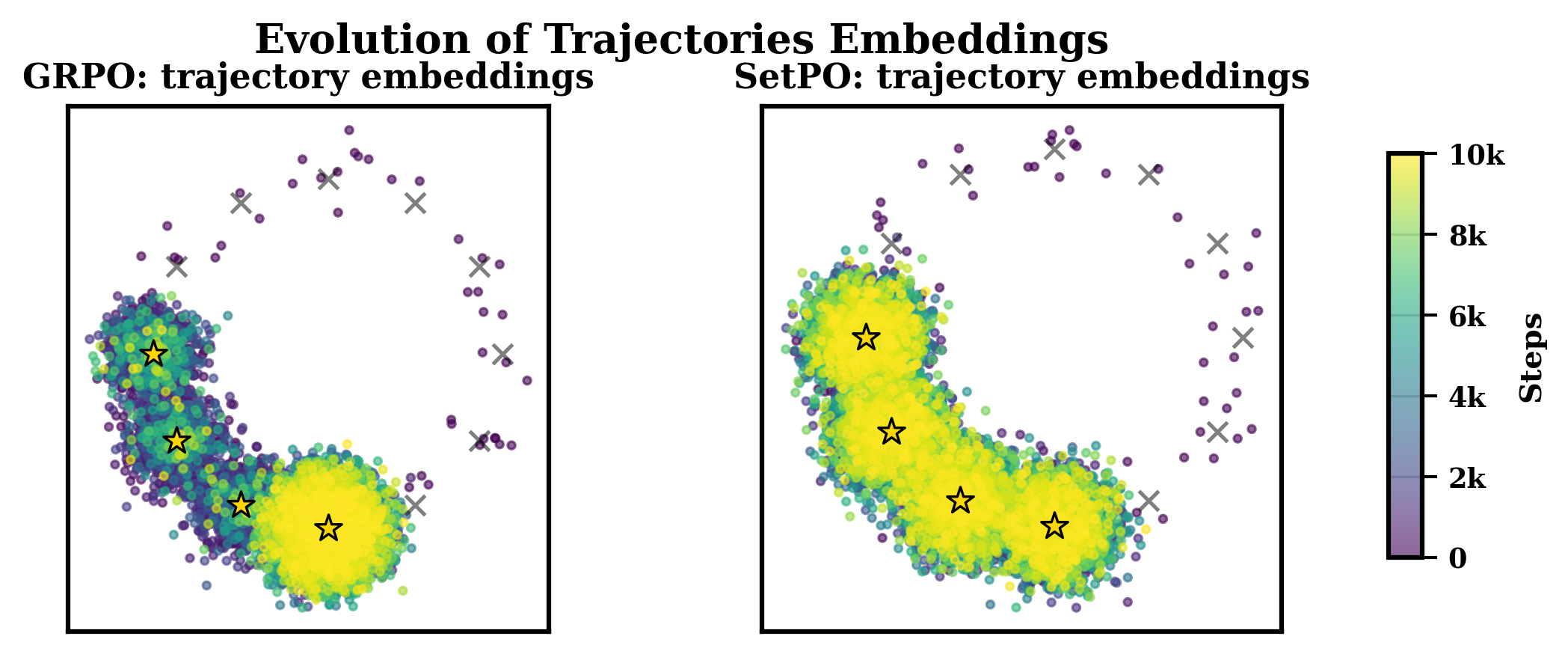
Since g is non-increasing, a smaller local mass yields a larger return. This mechanism rewards semantic novelty and prioritizes the preservation of highly unique trajectories.
SetPO contrasts the diversity estimate of the full generated batch Ω with that of the subset Ω ∖ {oi} to quantify the contribution of a single trajectory.
A larger si indicates that including oi yields a more significant gain in the estimated diversity of the set. A small or negative value suggests redundancy.
Starting from the base advantage Āi produced by GRPO, DAPO, or GSPO, SetPO adds the marginal diversity contribution as a plug-in shaping term. The coefficient λ controls the trade-off between task performance and diversity.
The augmented advantage Âi directly replaces the original base advantage in the corresponding GRPO, DAPO, or GSPO objective. SetPO modifies only the advantage term; the remaining design of the chosen base optimizer is unchanged.
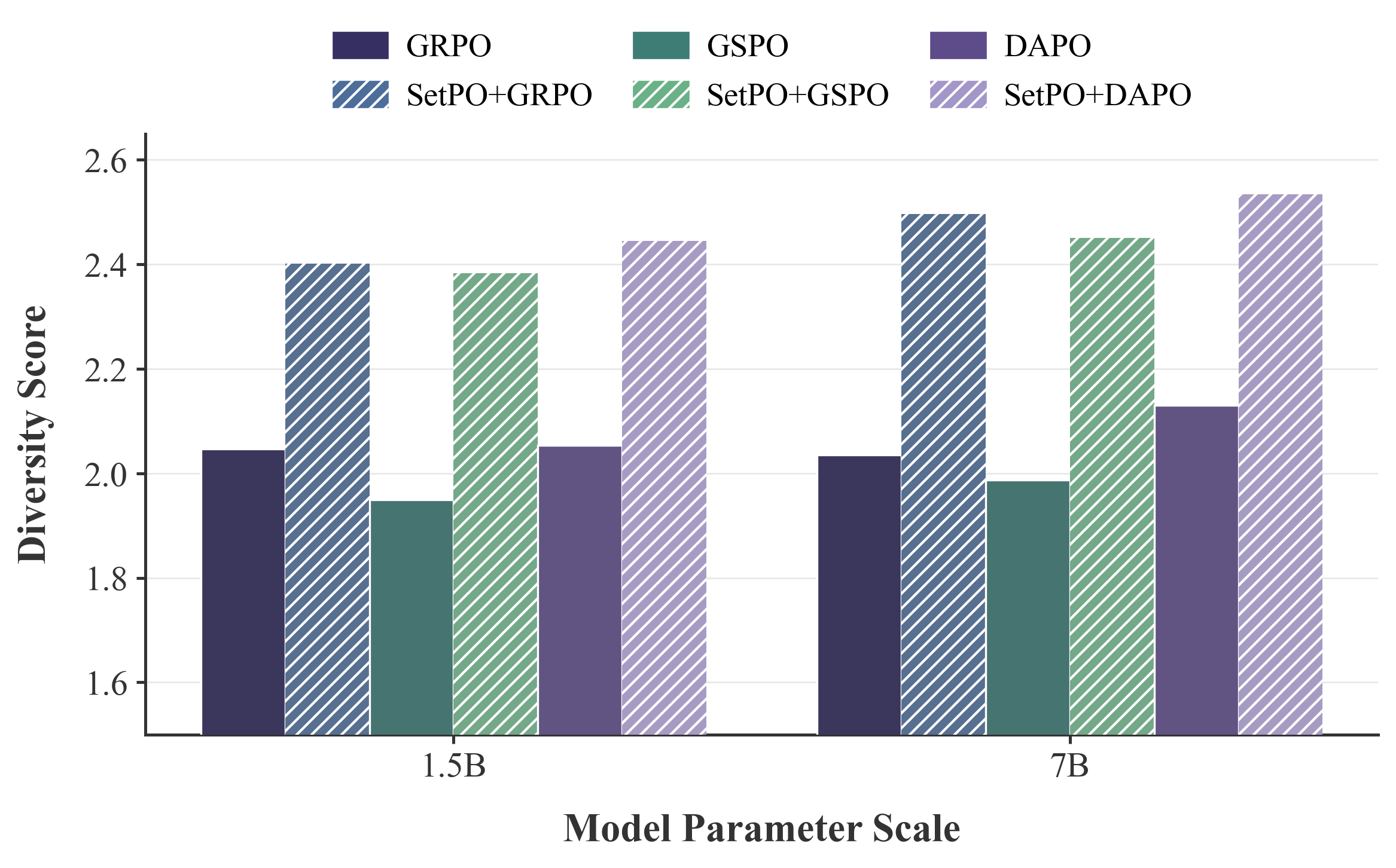
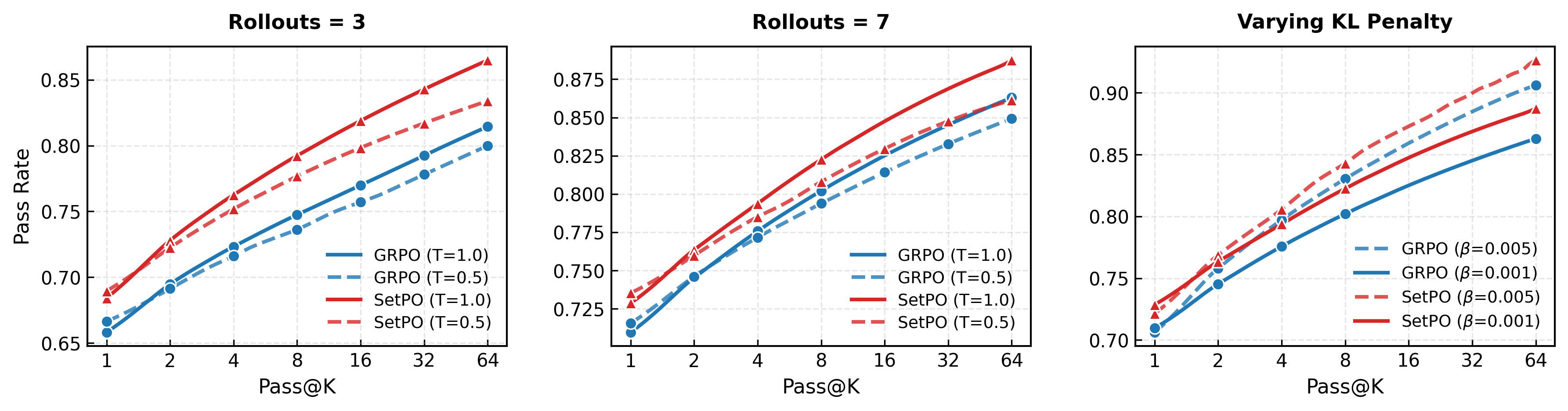
SetPO improves strong group-RL baselines across 1.5B, 7B, and 32B models.
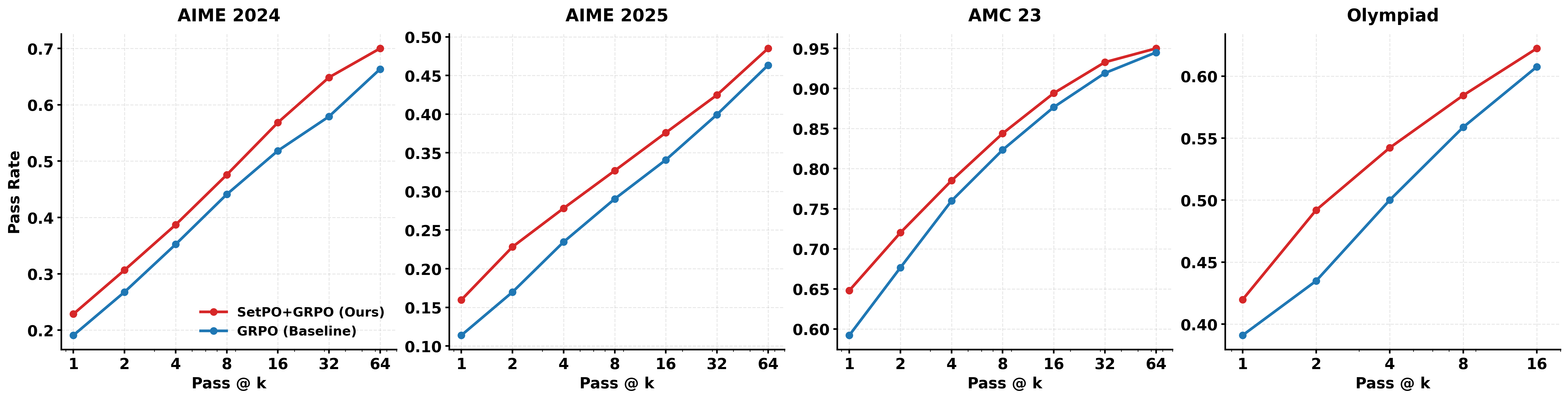
| Method | 1.5B | 7B |
|---|---|---|
| GRPO | 43.4 | 47.2 |
| SetPO + GRPO | 46.7 +3.3 | 52.8 +5.6 |
| GSPO | 43.2 | 48.4 |
| SetPO + GSPO | 45.2 +2.0 | 51.1 +2.7 |
| DAPO | 44.7 | 51.7 |
| SetPO + DAPO | 46.7 +2.0 | 53.8 +2.1 |
@article{setpo2026,
  title={SetPO: Set-Level Policy Optimization for
    Diversity-Preserving LLM Reasoning},
  author={Li, Chenyi and Zhang, Yuan and Wang, Bo
    and Ma, Guoqing and Tang, Wei and Huang, Haoyang
    and Duan, Nan},
  year={2026},
  eprint={2602.01062},
  archivePrefix={arXiv},
  primaryClass={cs.AI}
}